Overview
The Foundation Stack
Every advanced vocal technique — grit, falsetto, belt, vibrato, compression, breath-smoke — is a modification applied on top of a working base system. If the base is broken, the technique breaks too. A singer with poor breath support who adds grit gets strain. A singer who can't navigate their passaggio who tries to belt gets a shout. The techniques in the Voice Technique Guide assume this foundation exists.
The stack below is ordered. Each layer depends on the one beneath it. You can work on multiple layers at once — and you'll often find fixing a lower layer mysteriously resolves problems you thought lived higher up.
The stack below is ordered. Each layer depends on the one beneath it. You can work on multiple layers at once — and you'll often find fixing a lower layer mysteriously resolves problems you thought lived higher up.
1
Foundation Layer 1
Posture & Body Setup
The physical frame everything else happens inside. Alignment, released tension, open throat.
2
Foundation Layer 2
Breath Mechanics & Support
Diaphragmatic breathing, appoggio engagement, controlled subglottal pressure.
3
Foundation Layer 3
Cord Closure & Onset
Efficient glottal closure — the folds meeting cleanly without pressing or leaking. Clean attack with no breath waste.
4
Foundation Layer 4
Passaggio Navigation
Passing through the register break without flipping, cracking, or forcing. The gateway to full range.
5
Foundation Layer 5
Register Development
Building a reliable chest voice, mix, and head voice — and connecting them into a seamless range.
↑
Advanced Layer — Voice Technique Guide
Texture, Resonance & Colour
Grit, growl, compression, vibrato, breath-smoke, falsetto, belt, covered voice — all the tags in the Technique Guide live here. They are modifications applied on top of a working foundation.
How to use this guide: Work through the sections in order the first time. After that, treat it as a diagnostic — if something in your upper register sounds wrong, the problem is almost always in Layer 2, 3, or 4, not in the technique you were trying to execute.
Foundation Layer 1
Posture & Body Setup
The voice lives inside a body. The shape of that body — how it's aligned, where it holds tension, how the ribs and throat are positioned — directly determines how much the vocal instrument can do. Good singing posture is not about looking correct; it's about removing the physical obstacles that prevent the instrument from working.

Fig 1 — Collapsed vs. aligned posture. The body is the instrument's housing — tension and misalignment are physical resistance the voice has to work against.
The setup
Stand with feet roughly hip-width apart. Let the weight drop down through your legs into the floor — don't lock the knees. Stack the head gently over the shoulders so the ears sit above the hips. Lift the sternum slightly — not a military chest-out, just enough to open the ribs. Let the shoulders settle back and down without forcing them there. The neck should feel long and free. This is not an effortful position; if it feels like work to hold, you're doing too much.
The throat
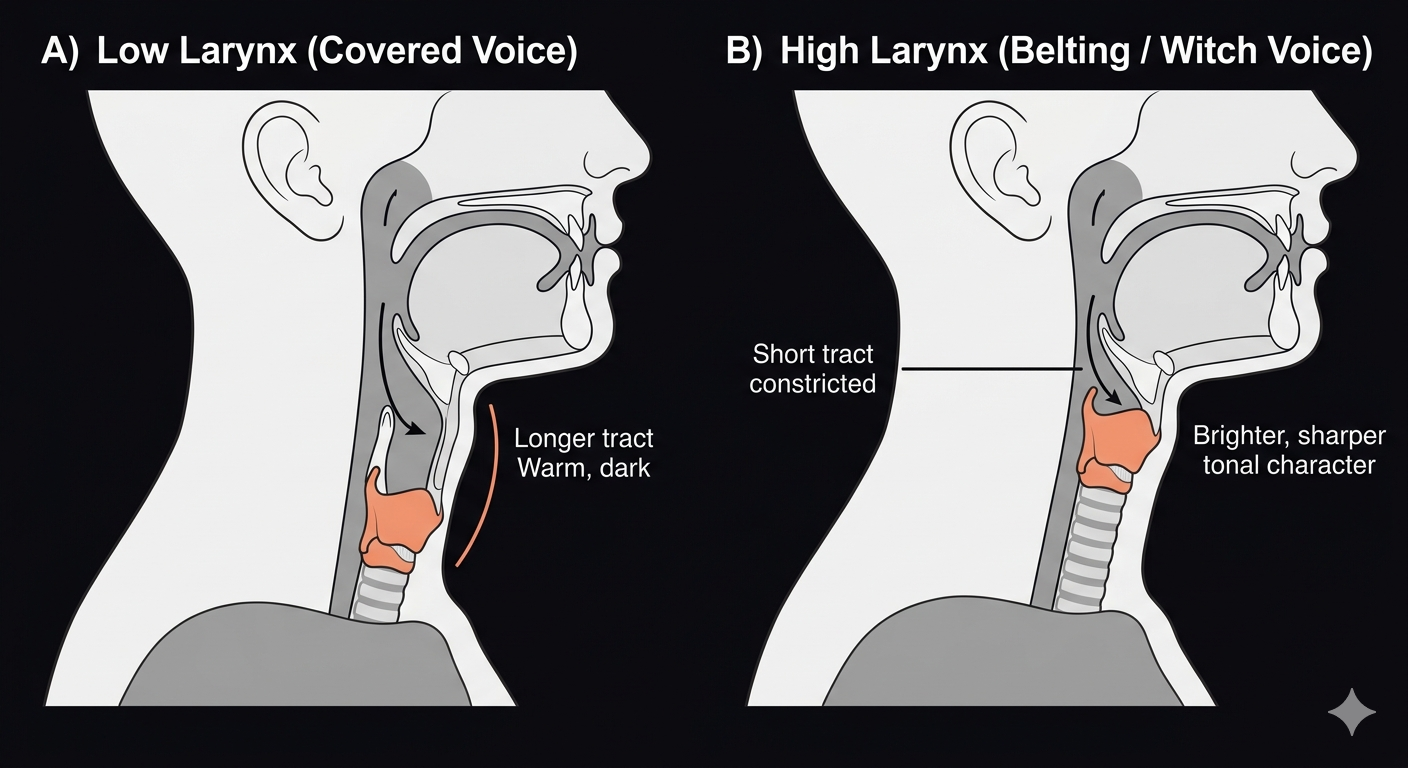
The single most destructive form of tension in singing is extrinsic laryngeal tension — the muscles around the outside of the larynx gripping and pulling it up or in. You can feel this: if your jaw, under-chin, or the sides of your neck tighten noticeably as you go higher, you have extrinsic tension. It limits range, creates strain, and is the root cause of most "my throat closes up" problems. The fix is not trying to relax during singing — it's learning what released feels like during low-stakes vocalisation first, so the muscle memory exists to draw from.
The jaw and tongue
The jaw should drop open on its hinge — not pushed forward or pulled back — with the tongue flat and wide in the mouth rather than bunching at the back. A bunched tongue narrows the pharyngeal space and raises the larynx. Practice singing with two fingers between your front teeth occasionally to train jaw release. The tongue should feel heavy and spread, not pointed or retracted.
Diagnostic test: Put two fingers lightly against the outside of your larynx (Adam's apple area) and sing up through your upper range. If you feel it shoot upward more than a centimetre or two, or if the muscles around it tighten under your fingers, extrinsic tension is present and limiting your range before any technique issue comes into play.
Foundation Layer 2
Breath Mechanics & Support
"Support your voice" is the most-given and least-explained instruction in singing. What it actually means mechanically: controlled management of subglottal air pressure — keeping the pressure below the folds steady across a phrase, rather than dumping it all at once or letting it collapse. The folds need consistent, calibrated pressure to vibrate efficiently. Too little and the tone is breathy and unsupported. Too much and the folds strain under excess pressure.
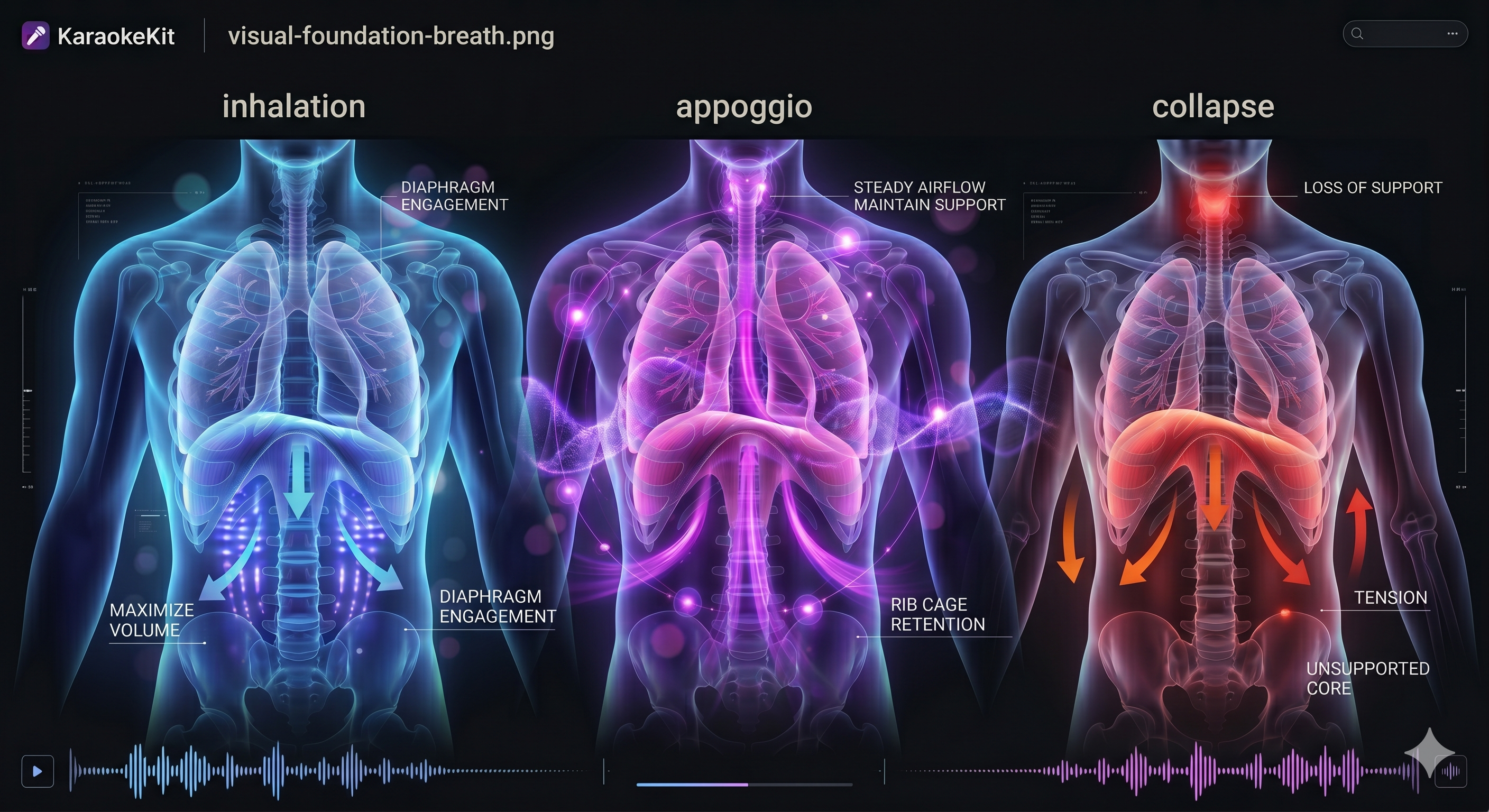
Fig 2 — Breath support states. Appoggio (centre) is the goal: the rib cage is held open against natural recoil, creating a controlled, steady pressure rather than a dump or a collapse.
Diaphragmatic breathing
The diaphragm is a dome-shaped muscle sitting below the lungs. When it contracts, it flattens downward, creating negative pressure that pulls air into the lungs. A deep breath should cause the belly to push outward (the descending diaphragm pushes the abdominal organs down and forward) rather than the chest and shoulders rising. Chest/shoulder breathing uses the secondary respiratory muscles — it's shallow, inefficient, and tires the neck muscles you need to keep relaxed for singing. The test: lie flat on your back and notice how you breathe naturally — the belly rises and falls, the chest stays relatively still. That's the mechanics you're after when standing.
Appoggio — the classical solution
Appoggio (Italian: "to lean") is the classical technique for breath support. After inhaling, you maintain the expanded rib-cage position of inhalation while singing — the intercostal muscles resist the natural elastic recoil of the ribs closing in. This creates a slow, controlled release of air pressure rather than a sudden dump. The abdominals engage gradually from below to provide steady upward pressure. The result: consistent subglottal pressure across the length of a phrase. Singers describe it as "singing on the breath" or "keeping the space." Physiologically, it's a managed tug-of-war between the expanding muscles (intercostals holding ribs out) and the collapsing tendency of the chest.
Practical exercises
1. Hiss exercise: Take a full breath into the belly, then release it on a slow "sss" hiss — try to make it last 20, then 30, then 40 seconds. The challenge forces your intercostals and abdominals to engage without you consciously thinking about them. You'll feel the sides of the ribcage working.
2. Staccato scales: Sing short, punchy staccato notes on a vowel. Each note requires a small abdominal engagement on the attack. This trains the abdomen to be the initiator of each note's pressure rather than the throat.
3. Phrase extension: Sing a phrase you know, then repeat it trying to end with more air in reserve than last time. The goal is not to conserve air by singing quietly — it's to support efficiently so less air wastes per note.
2. Staccato scales: Sing short, punchy staccato notes on a vowel. Each note requires a small abdominal engagement on the attack. This trains the abdomen to be the initiator of each note's pressure rather than the throat.
3. Phrase extension: Sing a phrase you know, then repeat it trying to end with more air in reserve than last time. The goal is not to conserve air by singing quietly — it's to support efficiently so less air wastes per note.
Key diagnostic: If your tone gets airier or weaker at the end of phrases — or if you run out of breath on phrases that seem short — the problem is almost always in Layer 2, not Layer 3 or above. Fix the breath first.
Foundation Layer 3
Cord Closure
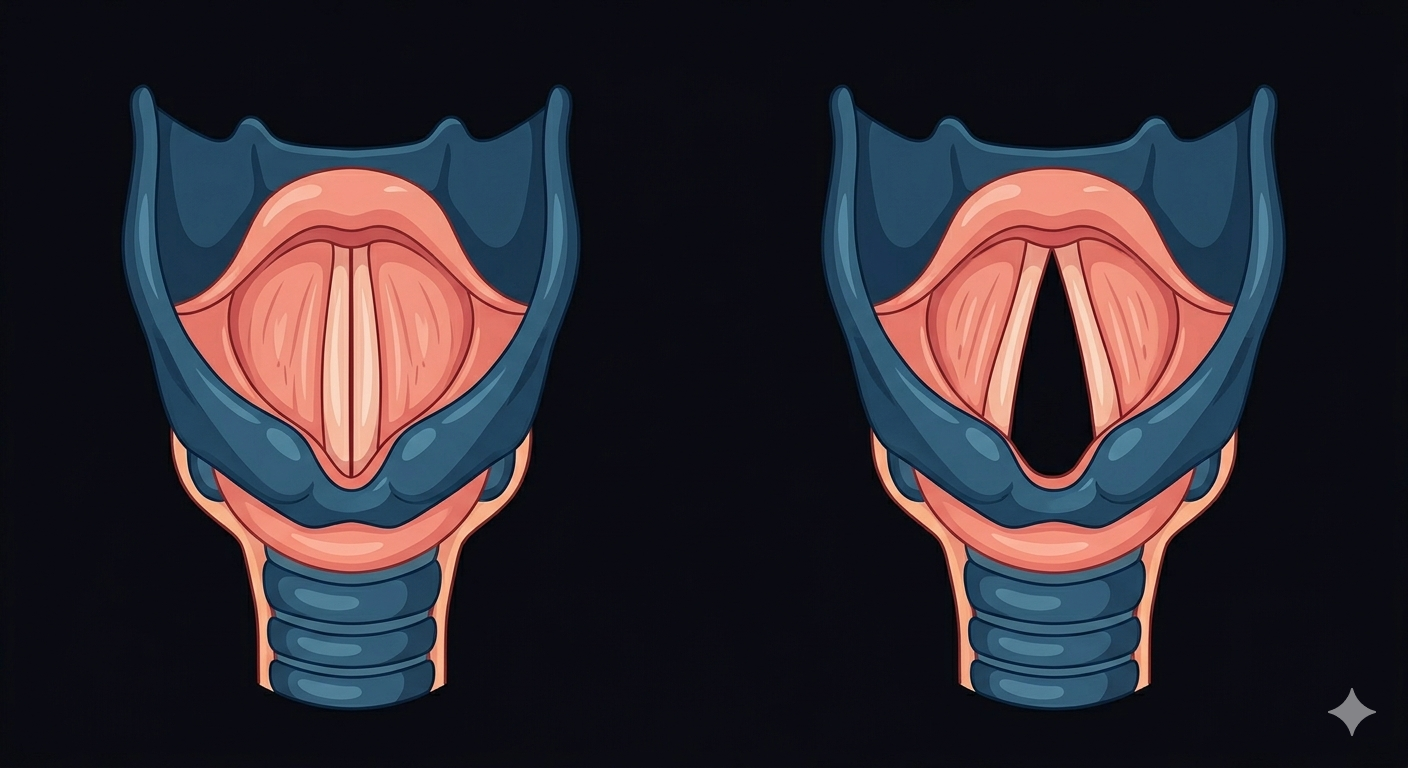
The vocal folds need to meet cleanly along their full length with each vibration cycle. Adduction is the closing of the folds; abduction is their opening. Good cord closure means the folds adduct enough to vibrate efficiently without pressing hard against each other. Too little closure = breathy, thin tone. Too much closure = pressed, strained, fatiguing tone. The goal is balanced adduction — sometimes called cord approximation or a clean glottal closure.
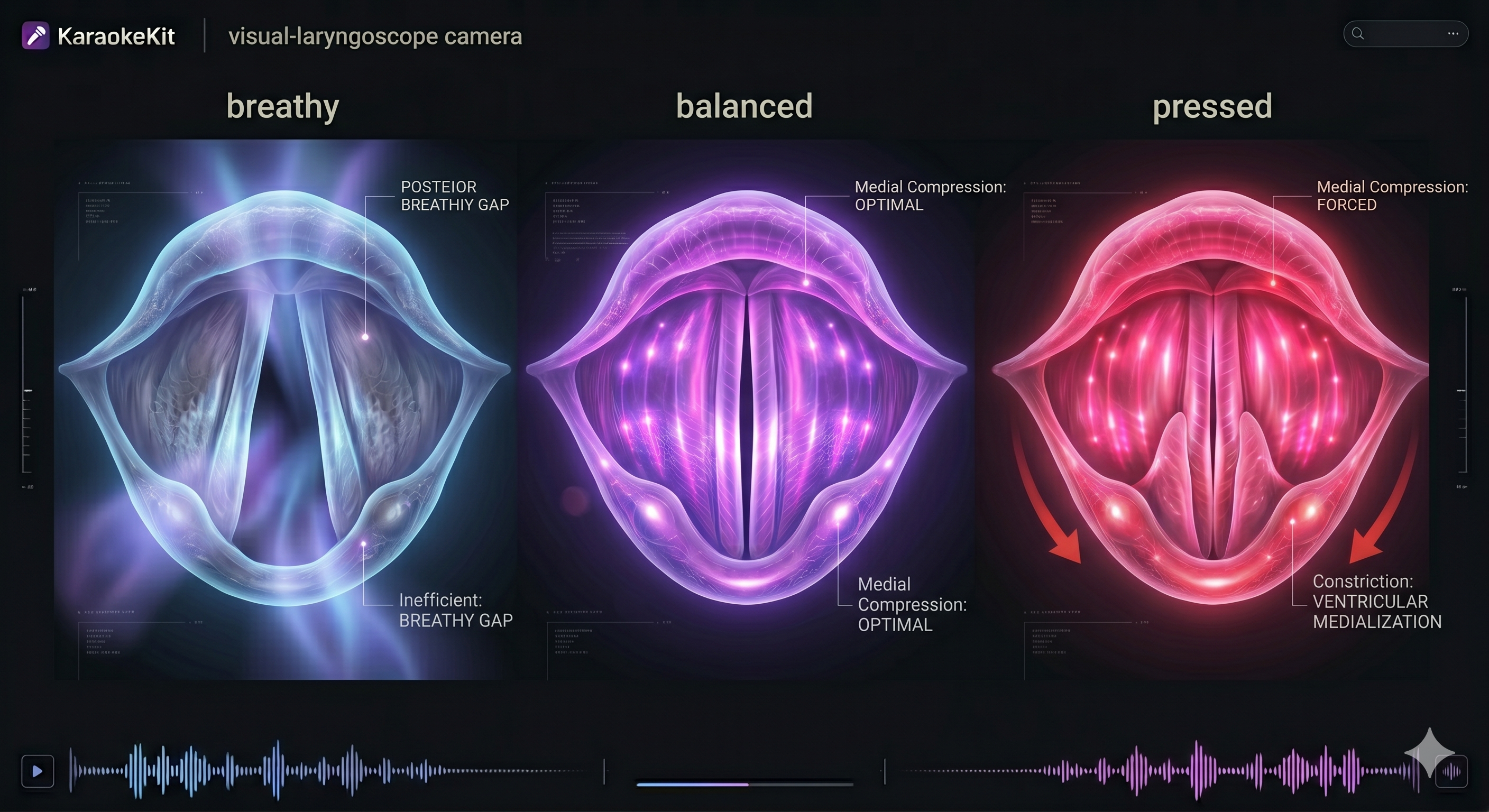
Fig 3 — Cord closure spectrum. Balanced adduction (centre) produces efficient vibration. Both extremes — too little or too much — create problems that technique cannot fix from above.
Training closure without pressing
The best exercises for cord closure are ones that encourage the folds to meet firmly but without the extrinsic muscle tension that causes pressing. Lip trills / lip bubbles are effective: the back-pressure created by the buzzing lips regulates subglottal pressure and forces the folds to find their own natural closure rather than being squeezed by external effort. Sirens on "ng" (the sound in "singing") also work well — the ng position keeps the throat open while the folds close cleanly for the tone. Straw phonation (singing through a thin straw into water) provides similar back-pressure regulation.
The breathiness problem
Many singers — especially those who developed voice in a pop/indie context — have a habitual glottal chink: a small gap at the back of the folds that never fully closes. This reads as a permanent breathy quality and limits power, projection, and the ability to sustain tone. It is not a character choice when it's the only option available. Training clean closure gives you access to both clean and deliberately breathy sounds (as in TEX-breath-smoke) — the difference being that one is a choice and one is a default you can't escape.
Foundation Layer 3 (cont.)
Onset Types
The onset is how a note begins — specifically, the relationship between the start of airflow and the start of fold vibration. It's one of the clearest diagnostic windows into the health of a singer's technique. There are three types.
Aspirate Onset
Air flows before the folds close — you hear a "h-" before the note. Breathy attack, wasted air, folds close late. Common in untrained and folk/indie singers as a default.
Caution — air waste
Simultaneous Onset
Air and fold vibration start at exactly the same moment. Clean, clear, efficient. No wasted air, no glottal click. This is the goal for most singing contexts.
Goal
Glottal Onset
Folds close fully before airflow — air builds pressure then blows them apart with a hard click or pop. Stresses the folds. Sometimes used deliberately for percussive effect, but damaging as a default.
Avoid as default
Training the simultaneous onset
The most direct way to train simultaneous onset is singing through an "h" intentionally, then gradually removing it while keeping the airflow timing the same. Start with "hah… hah… hah…" — clean, even, no click — then reduce the h to a breath-onset, then to nothing. The note should start with the same quality of airflow and closure. Another route: singing on a slow scale starting with "mmm-ah" — the nasal resonance on the "m" establishes fold vibration before the vowel opens, training the folds to be active and adducted before the onset demand arrives.
Foundation Layer 4
Passaggio Navigation
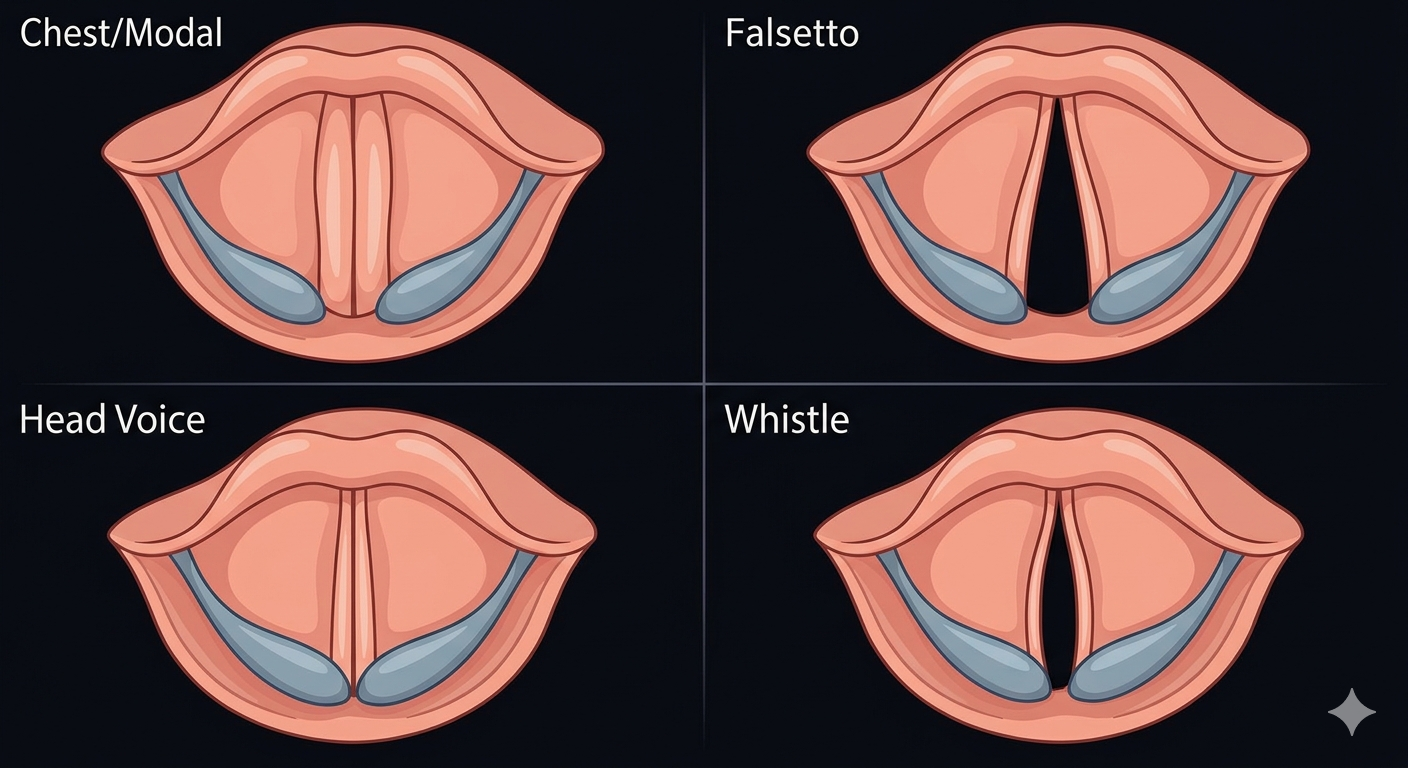
The passaggio (Italian: "passage") is the register break — the zone in the pitch range where the laryngeal mechanism wants to switch from the TA-dominant chest-voice configuration to the CT-dominant head-voice configuration. It is not a flaw to be hidden; it is a structural feature of the instrument that every singer must learn to navigate. The quality of a singer's passaggio navigation is often the single biggest determinant of their effective range.
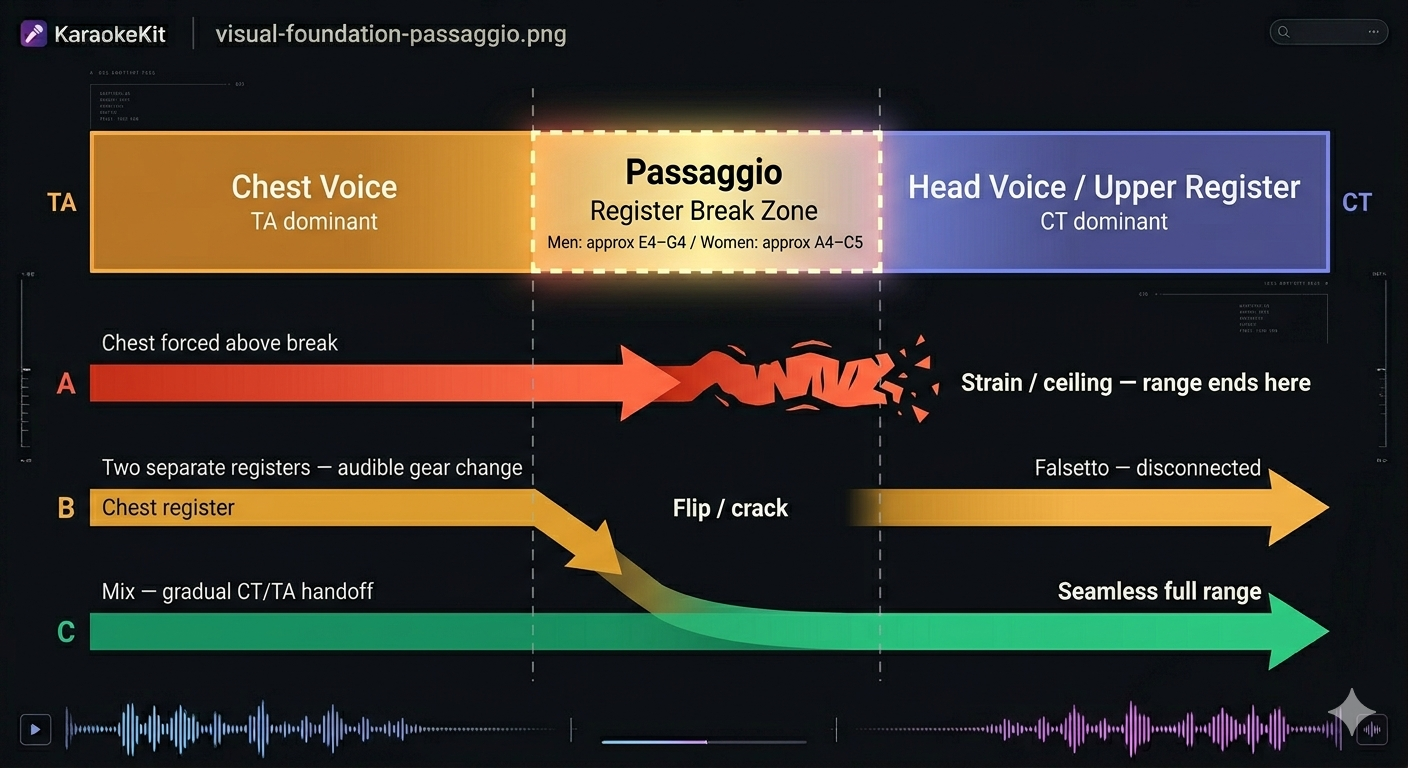
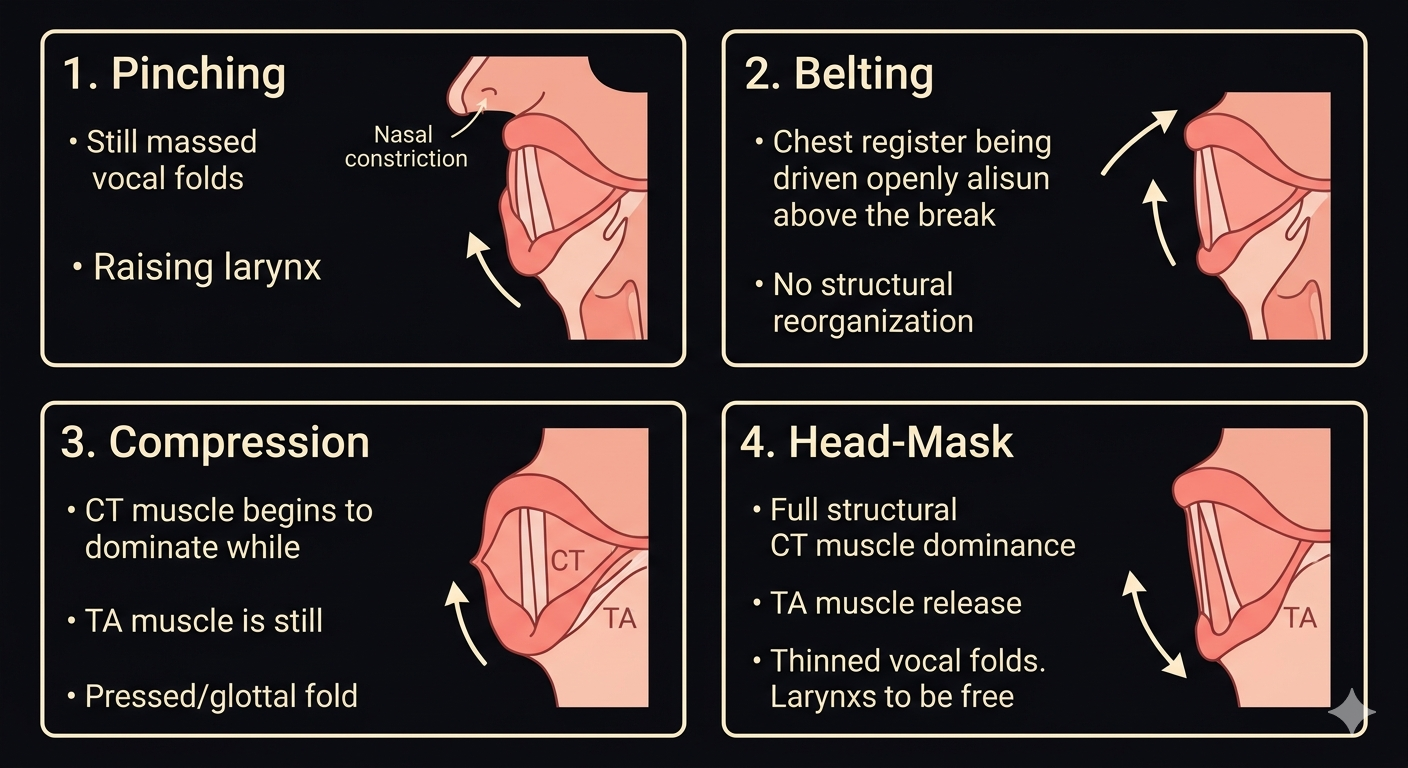
Fig 4 — Three navigation strategies through the passaggio. Only the mix/blend path produces a seamless, usable range — the other two produce either a wall or a gap.
What's actually happening
As pitch rises, the cricothyroid (CT) muscle increasingly takes over from the thyroarytenoid (TA). The CT lengthens and thins the folds to raise pitch. The TA resists this — it's the mass contributor, the chest-voice engine. In the passaggio zone, both muscles are competing for dominance. The flip or crack happens when the TA suddenly gives up rather than gradually releasing. The sensation of "breaking" is the TA releasing too abruptly. The goal is a graduated handoff — the CT progressively takes more authority while the TA releases slowly enough that the tone never goes hollow or suddenly flips.
Forcing chest above the break
Driving full TA-dominant chest voice above the passaggio. The CT is being overridden by sheer pressure. Eventually hits a ceiling — the voice cracks, the note disappears, or the singer strains. This is not belt (which is a coordinated yell-level system) — it's just driving the wrong mechanism past its range.
The flip / abrupt register switch
The TA releases all at once and the voice flips into falsetto (CT dominant, incomplete closure). Audible as a sudden change in quality — yodel-like, two separate voices. Not a mechanical failure but a coordination failure: the TA let go before the CT built enough tension to take over cleanly.
Mix / blended passage — the goal
The CT builds tension progressively while the TA releases gradually. Neither takes over suddenly. The tone stays consistent through the break — changing slightly in character (lighter, more focused) but not cracking or flipping. This is the mechanism behind "mixed voice," "voix mixte," and the operatic mezza voce.
Training the passage
Slow sirens: Slide slowly and smoothly from low to high on a gentle "ooh" or lip trill, aiming to pass through the break without cracking or flipping. Slow speed gives the muscles time to negotiate. If you flip, back up and approach more gradually.
Approaching from above: Start in head voice on a high note and slide down through the passaggio, rather than driving up from chest. This trains the CT to maintain its claim while the TA reactivates, rather than TA trying to fight its way up.
Vowel modification: Closed vowels like "oo" and "ee" naturally encourage mix — the vocal tract shape for these vowels discourages the full-mass chest configuration. Practising passages on these vowels first, then transferring to open vowels, helps encode the blended coordination.
Approaching from above: Start in head voice on a high note and slide down through the passaggio, rather than driving up from chest. This trains the CT to maintain its claim while the TA reactivates, rather than TA trying to fight its way up.
Vowel modification: Closed vowels like "oo" and "ee" naturally encourage mix — the vocal tract shape for these vowels discourages the full-mass chest configuration. Practising passages on these vowels first, then transferring to open vowels, helps encode the blended coordination.
Foundation Layer 5
Register Development
Once the passaggio can be navigated cleanly, the work becomes developing each register fully and then integrating them. Most singers have an uneven instrument — a strong chest voice and a weak or underdeveloped head voice, or vice versa. Strength and agility in all registers is what gives the advanced techniques somewhere to live.
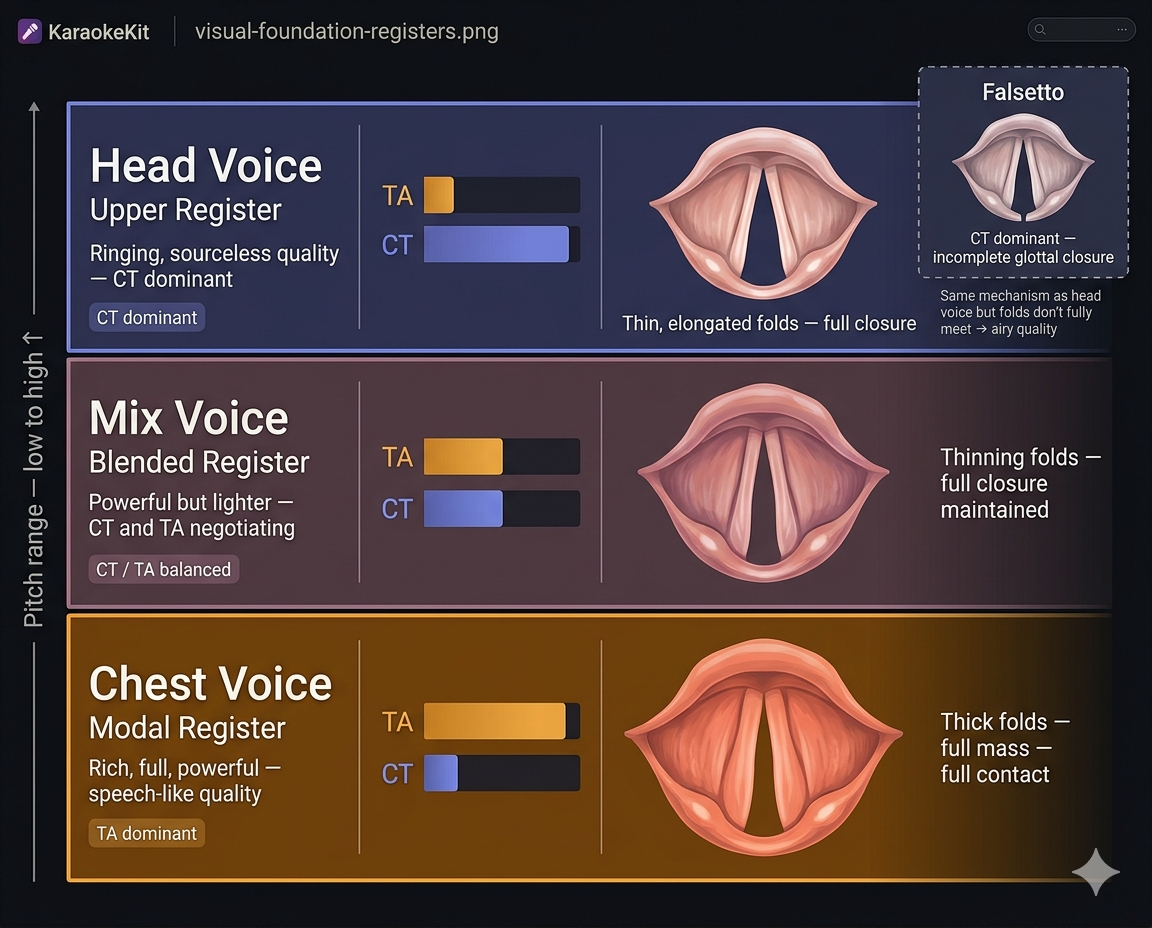
Fig 5 — The three main registers and their muscle configurations. Developing each fully, then connecting them through the passaggio, produces a complete, even instrument.
Building Chest Voice
TA dominance · mass · power
Chest voice needs resonance and projection, not volume for its own sake. Speak-sing exercises ("yelling" a note on a word you'd shout) connect you to the uninhibited chest mechanism. Slides from chest up toward the break and back down. Scales on "gah," "bah," open vowels with full engagement — not holding back. The risk area is driving too high in chest; the development area is widening the range and strengthening the lower-middle register.
Building Head Voice
CT dominance · thinning · ring
Head voice is underdeveloped in most untrained singers because it requires trusting a configuration that feels unsupported. Starting high and coming down is more productive than fighting up to it. Falsetto-to-head-voice transitions (moving from incomplete to full closure in the CT-dominant mechanism) — the moment the airiness of falsetto snaps into the ring of full head voice closure is the sensation to chase. Humming in the upper register, "ng" scales above the break, hooty "ooh" descents.
Building Mix
CT/TA balance · handoff · blend
Mix is not a third register — it's the coordinated overlap zone where both muscles are active. You cannot consciously operate the CT and TA individually. What you can do is adjust vocal tract shape, vowel, and onset quality to encourage one or the other. Brighter/more forward vowels pull toward chest weight; darker/more rounded vowels encourage thinning. Building mix is mostly about building the passaggio navigation (Layer 4) and applying it to more and more vowels and pitches.
Integration
full range · seamless · even
A fully integrated voice has consistent tone quality across the range — not the same timbre (it will naturally change), but a consistent ease and resonance that doesn't have a "here's where I struggle" zone. The test: can you sing a slow scale from low chest to high head and back without any note feeling harder than the others, without any flip or audible gear-change? That evenness is the goal. Everything in the Voice Technique Guide runs on top of that.
Where to go next
You Have a Foundation. Now What?
Once you have consistent breath support, clean cord closure, a navigable passaggio, and developing registers, you're ready to start working on the technique layer. This is where the Voice Technique Guide and the Artist Profiles become practical tools rather than abstract references — because you now have an instrument capable of executing them.
The order of diagnosis: When something goes wrong in a technique — your grit sounds strangled, your falsetto won't sit, your belt cracks — work backwards through the stack before assuming it's a technique problem. Layer 2 (breath) accounts for probably 60% of technique failures. Layer 3 (closure/onset) for another 20%. Layer 4 (passaggio) for most of the rest. The technique itself is rarely the issue.
Disclaimer: The technique descriptions on this page represent pedagogical consensus and functional models derived from voice science and established teaching frameworks. They are not clinical findings. For rigorous scientific grounding: Complete Vocal Technique (Cathrine Sadolin, CVI) and The Estill Voice Model (Jo Estill / Kimberly Steinhauer) are the most rigorous style-independent frameworks. For academic voice science: The Science of the Singing Voice (Johan Sundberg) is the standard reference text.
Building A Rockstar Foundation · v1.0 · April 2026 · 5 diagrams (Gemini visual placeholders)